



If everyone has Copilot, do we still need to deliver learning in the workplace?


After literally years of wrestling with Microsoft Word templates to keep my proposals on brand, I discovered Copilot can automatically apply our company branding to documents and presentations.
For me it’s been a huge time-saver – and one less thing I need to learn.
Better still, it’s one less thing our marketing team needs to remind us about or create training videos for.
That got me thinking: if Copilot can guide us through the tasks we need to complete at work, do organisations still need to invest so much time and effort in creating and delivering learning content?

Does Copilot mean the end of online training content?
I don’t think so. What it does mean is that we need to rethink what we’re teaching.
The reality is that employees now have instant access to guidance while they’re working. Instead of searching for a course or trying to remember what they learnt six months ago, they can simply ask Copilot:
“How do I create a pivot table?”
“Can you explain what this Excel formula does?”
“Show me how to create a Power Automate flow.”
“Summarise our expenses policy.”
Instead of learning and remembering how to do these things, you can ask Copilot to do it!
Learning needs to change with AI
So in short, Copilot isn’t eliminating the need to deliver learning for L&D teams, we just need to start teaching different things.
Instead of investing time creating courses that explain which menu to click or which button to press, organisations have an opportunity to develop the skills that AI can’t replace.
Here are five areas where workplace learning will become even more important.
1. Knowing when Copilot is wrong!
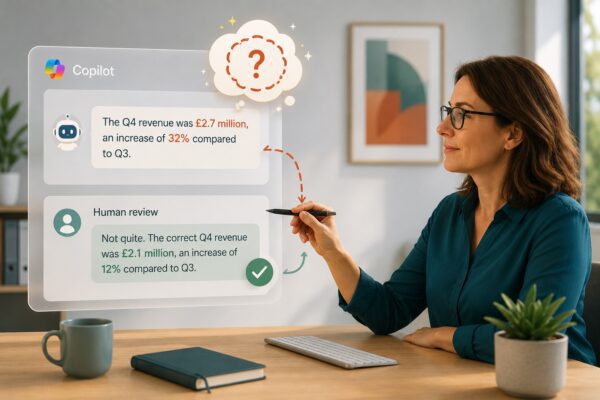
Copilot can produce an answer in seconds. As with other AI platforms, it can also produce an answer that hallucinates (complete bobbins, as we call it).
This is a really big thing to watch out for, and one of the most valuable skills employees can develop is the ability to question, challenge and validate what they’re being told.
Training shouldn’t just explain how to use AI. It should help people understand when not to trust it.
2. Asking AI better questions
One of the biggest misconceptions about AI is that it’s all about writing clever prompts.
In reality, it’s about learning how to communicate clearly.
The better the context you provide, the clearer you explain the outcome you’re trying to achieve and the more effectively you refine your questions, the better Copilot performs.
Equally important is being clear and specific to Copilot about the source information you want it to reference. If you don’t, it can go ‘off piste’ and provide outputs which are not relevant or correct for your requirement.
In fact, Microsoft recommends a simple framework for writing better prompts called GCSE: Goal, Context, Source and Expectations. It’s less about learning ‘prompt engineering’ and more about learning to communicate clearly. The more specific you are about what you’re trying to achieve, the information Copilot should use and the format you want back, the better the results are likely to be.
3. Using AI safely and responsibly
As organisations embrace AI, they’re also having to teach people how to use it responsibly.
- What information is appropriate to share?
- What shouldn’t be uploaded?
- How should confidential information be handled?
- When is it appropriate to rely on AI, and when should a human make the decision?
- These questions are becoming just as important as learning how to use the technology itself.

4. Sharpening up ‘Soft skills’
I recently read about how the ‘wheels can fall off’ where people use AI to help with online dating.
AI crafts witty, thoughtful replies. It remembers details from previous conversations. It asks engaging questions. Everything seems to be going brilliantly…
…until the first date ‘IRL’.
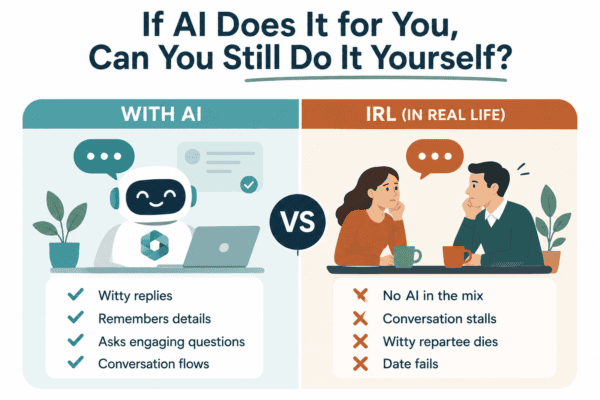
Suddenly there’s no AI in the mix and the conversation stops flowing, the witty repartee dies, the date fails.
The same applies in the workplace.
Copilot can help draft an email, prepare a presentation or even suggest how to respond to a difficult customer.
But it can’t build trust with a client, negotiate a complex agreement, inspire a team through change or take responsibility for a difficult decision.
Those remain distinctly human capabilities.
As AI becomes more capable, organisations should be investing in skills such as:
- Building trust and long-term relationships
- Influencing and negotiating
- Leading people through change
- Commercial and ethical judgement
- Creative problem solving
- Decision making under uncertainty
- Taking ownership and accountability
Ironically, these “people skills” may become some of the most valuable skills in the organisation. Because when everyone has access to the same AI tools, it’s the quality of the human behind the keyboard that makes the difference.
5. Learning things that aren’t written down
If you think back to the last time you learnt something really valuable at work, it probably wasn’t in an online training course.
More likely it was over a coffee, chatting in the pub after work, sitting in on a customer meeting or observing someone sitting right next to you. In other words, learning on the job.
Those ‘in person’ learning experiences are what many organisations are striving to achieve – especially in this day and age where many of us are working remotely for a good chunk of time.
So whilst Copilot can answer questions about your business, it can’t replace the shared and ‘IRL’ experiences that meeting and learning on the job or in the classroom can.
So do we still need workplace learning?
100%
Organisations still need to onboard new employees, deliver and track compliance training, complete ‘in person’ assessments, manage certifications, assign learning pathways and demonstrate that mandatory learning has been completed.
Those requirements don’t disappear simply because AI can answer questions.
What changes is the content of that learning.
Instead of spending valuable time teaching employees where to find a feature in Microsoft Word or Excel, organisations can spend more time helping people develop judgement, confidence, critical thinking and responsible AI practices.
Those are skills that will remain valuable long after today’s software features have changed.
It turns out that Microsoft’s latest 2026 Work Trend Index reaches much the same conclusion.
Rather than suggesting organisations need less learning, it argues they need to become “Learning Systems” – developing cultures where employees continuously build the judgement, adaptability and AI skills needed to work effectively alongside intelligent agents.
Microsoft also concludes that organisations with strong learning cultures, supportive managers and effective talent practices achieve significantly greater benefits from AI than those that simply deploy the technology.